From Beginner JavaScript to a Real Backend API: Building a Community Platform Step by Step
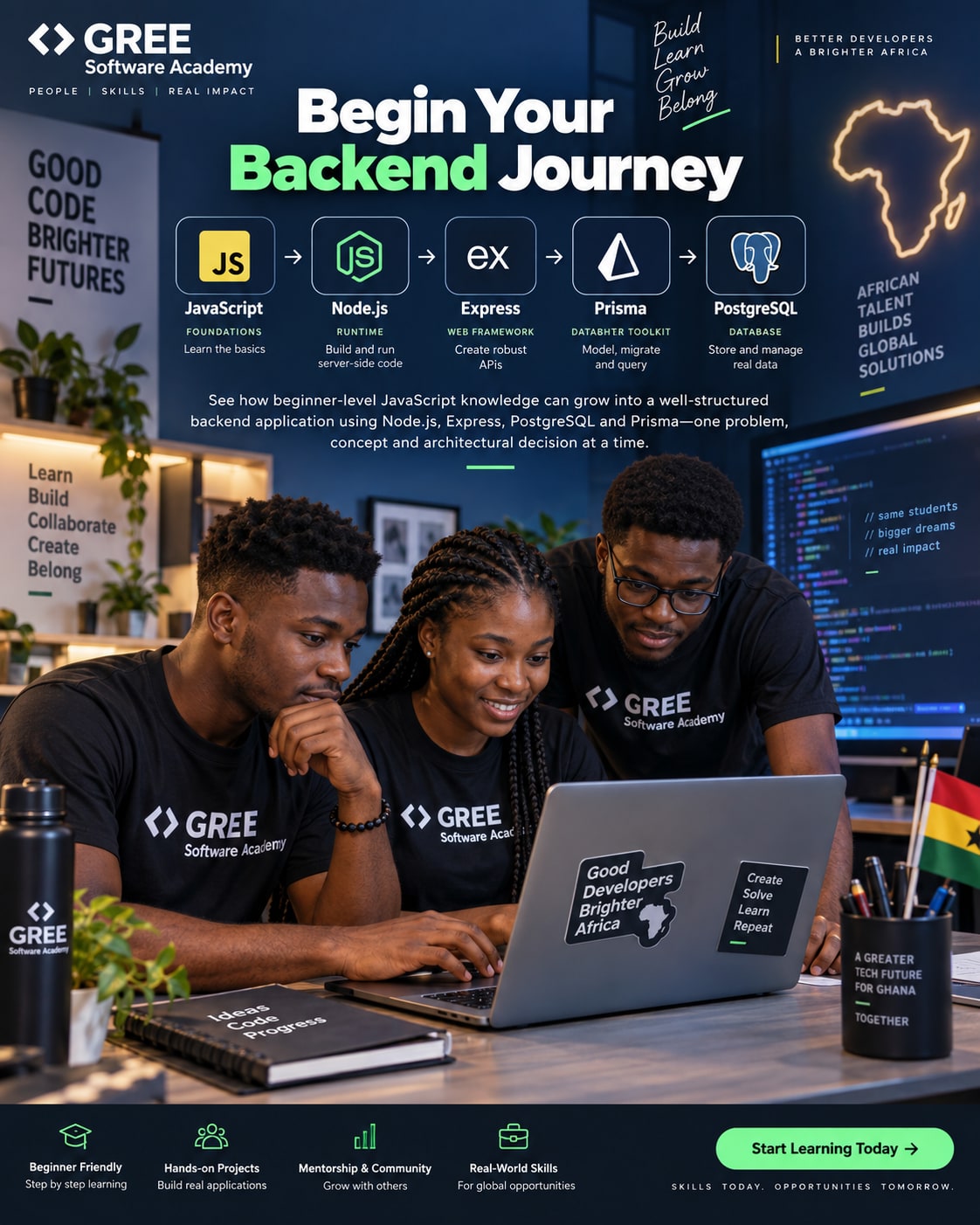
Follow our step-by-step Backend Development series and see how beginner JavaScript knowledge can grow into a structured application using Node.js, Express, PostgreSQL and Prisma—one problem and architectural decision at a time.

# From Beginner JavaScript to a Real Backend API
From Beginner JavaScript to a Real Backend API
Learning JavaScript syntax is important.
But learning how to turn that knowledge into a real application that solves a real-world problem is where software development becomes much more interesting.
At GREE Software Academy, we are building a complete backend application step by step using beginner-friendly JavaScript concepts.
The goal of this series is not simply to show you finished code.
Instead, we want to understand:
Why does each piece of the application exist?
What problem does it solve?
Why do we introduce a particular folder, package, database or architectural pattern?
And most importantly:
How can someone with a good understanding of JavaScript fundamentals gradually build a properly structured backend application?
The Project We Are Building
Throughout this series, we will build the backend for a simple Community Information Platform.
Imagine a local community that currently depends heavily on:
- WhatsApp groups
- Social media
- Group chats
- Personal messages
- Word of mouth
to distribute information such as:
- Announcements
- Educational information
- Scholarship opportunities
- Job opportunities
- Events
- Community notices
The problem is that this information quickly becomes scattered.
An important message posted today may be buried underneath hundreds of unrelated conversations tomorrow.
Someone may also miss an important opportunity simply because they were not online when it was shared.
So we begin with a simple question:
How can technology make this information easier to publish, organize and retrieve?
The Solution
We will design a central digital platform where authorized people can publish important information and community members can access it whenever they need it.
Instead of searching through months of group conversations, users can visit one platform and find organized information.
Our system will gradually support concepts such as:
- Users
- Posts
- User roles
- Publishing
- Editing
- Archiving
But we are not going to build everything at once.
That is the most important idea behind this series.
The Way We Will Learn
Many backend tutorials begin by showing a large project structure like:
textsrc/
├── controllers/
├── middleware/
├── models/
├── routes/
├── services/
├── utils/
├── validators/
Then the learner is told to create every folder immediately.
The problem is that a beginner may know what the folders are called, but still not understand why they exist.
We are taking a different approach.
Our application will grow naturally.
For example:
textEverything inside server.js
        ↓
Too many endpoints
        ↓
Introduce routes/
Then later:
textToo much logic inside routes
        ↓
Introduce controllers/
Then:
textTemporary JavaScript data disappears
        ↓
Introduce PostgreSQL
Then:
textJavaScript needs a clean way to communicate with PostgreSQL
        ↓
Introduce Prisma
This allows us to understand architecture as a response to problems, rather than something we memorize.
Starting With Beginner JavaScript
We are intentionally beginning with JavaScript before moving into TypeScript.
You do not need to know every advanced feature of JavaScript before starting this series.
The concepts we will repeatedly use include:
- Variables
- Constants
- Functions
- Arrow functions
- Arrays
- Objects
Individually, many of these concepts are beginner-level JavaScript.
The real skill comes from learning how to combine them.
For example, something like:
jsconst posts = await prisma.post.findMany();may initially look advanced.
But break it down:
jsconst postscreates a variable.
jsawaitwaits for asynchronous work.
jsprisma.post.findMany()calls a method.
Backend development gradually teaches us how familiar JavaScript concepts work together inside a larger system.
Our Technology Stack
Throughout the project, our backend will gradually introduce the following technologies.
JavaScript
The main programming language used to write our application logic.
Node.js
Allows JavaScript to run on the server.
Express
Helps us build HTTP servers, API routes and request handlers.
PostgreSQL
Provides permanent storage for our application data.
Prisma
Helps our JavaScript backend communicate with PostgreSQL.
pnpm
Manages our packages and dependencies.
Our eventual relationship will look roughly like this:
textJavaScript
    ↓
Node.js
    ↓
Express
    ↓
Prisma
    ↓
But every tool will only be introduced when we understand the problem it solves.
The Backend Development Series
This main article serves as the starting point for the entire learning journey.
Each individual update focuses on one manageable part of the system.
Update 1 — From JavaScript Syntax to Solving Real Problems
We begin before writing code.
This update focuses on:
- Programming as a problem-solving tool
- Understanding the community problem
- Identifying Users
- Identifying Posts
- Thinking about permissions
- Turning requirements into software ideas
The most important lesson is:
The problem comes before the technology.
Update 2 — Setting Up Your First Modern Node.js Backend Project
Once the problem is understood, we create the actual backend project.
We explore:
- Node.js
package.json- pnpm
- ES Modules
importandexport
Our initial project remains intentionally small:
textcommunity-platform-api/
│
├── src/
│   └── server.js
│
├── .gitignore
└── package.json
Update 3 — Building Your First Express Server
Next, we turn the empty Node.js project into a real server.
We learn:
- What Express is
- What a server is
- What a port is
- What
localhostmeans - What a route is
The request flow begins to look like:
textClient
   ↓
HTTP Request
   ↓
Express Server
   ↓
Processing
   ↓
Update 4 — Organizing the API With Routes
As the application grows, putting every endpoint inside server.js becomes difficult to manage.
This introduces:
textroutes/We will understand:
- API routes
- HTTP methods
- Express Router
- Resource-based routing
/api/posts- How requests move from the main server into dedicated route files
Update 5 — Building CRUD Operations
Our Post resource needs real operations.
We will build:
textGET     /api/posts
GET     /api/posts/:id
POST    /api/posts
PATCH   /api/posts/:id
DELETE  /api/posts/:id
We will also understand:
- CRUD
- Route parameters
- Request bodies
express.json()- HTTP status codes
- Temporary JavaScript data
Update 6 — Introducing Controllers
As the route file grows, another architectural problem appears.
Routes begin containing too much application logic.
That gives us a reason to introduce:
textcontrollers/The separation becomes:
textRoute
   ↓
Which function handles the request?
and:
textController
   ↓
What should actually happen?
Update 7 — Designing the Database
Before installing a database, we first understand what our system needs to store.
We will explore:
- Tables
- Rows
- Columns
- Users
- Posts
- Primary keys
Our first major relationship becomes:
textONE USER
    ↓
CAN CREATE
    ↓
MANY POSTS
Update 8 — Introducing PostgreSQL and Prisma
Our temporary JavaScript data disappears whenever the server restarts.
That creates a real need for persistent storage.
We will introduce:
- PostgreSQL
- Prisma ORM
- Prisma Client
- Prisma Migrate
- Environment variables
- Database connection strings
The architecture moves toward:
textExpress Application
        ↓
      Prisma
        ↓
    PostgreSQL
Update 9 — Creating Real Database Models
Our database design will become actual Prisma models.
We will create structures for:
textUser
Post
Role
PostStatus
and understand:
- Required fields
- Optional fields
- Unique fields
- Primary keys
- Foreign keys
- Enums
Update 10 — Connecting the API to PostgreSQL
Finally, our Express application begins retrieving real persistent data.
The full flow becomes:
textCLIENT
   ↓
HTTP REQUEST
   ↓
EXPRESS
   ↓
ROUTES
   ↓
At this point, our backend has evolved from a single JavaScript file into a properly structured application.
Follow the Series in Order
If you are learning Backend Development, I recommend following the updates in order.
textUpdate 1
Problem Solving
    ↓
Update 2
Node.js Project Setup
    ↓
Update 3
Express Server
Each update builds on the previous one.
What Happens After Update 10?
Reaching the database is not the end of the project.
It gives us the foundation needed for much more.
Later lessons can explore:
- Creating real Users
- Creating permanent Posts
- Password hashing
- Registration
- Login
- Authentication
The same learning principle will continue:
Introduce a concept when the application develops a real reason for it.
Why This Approach Works
Consider how the project evolves.
We don't start here:
textLarge ApplicationWe start here:
textOne ProblemThen:
textOne Problem
    ↓
One Small Solution
    ↓
New Requirement
    ↓
New Limitation
    ↓
Repeated enough times, that process eventually produces a complete system.
Beginner Does Not Mean Incapable
Being a beginner does not mean you can only build:
- Calculators
- Counters
- Todo lists
- Random number generators
Those projects are useful for learning individual concepts.
But once you understand the fundamentals, you should begin combining them to solve realistic problems.
The trick is not to build everything at once.
Instead:
textBuild Server
    ↓
Understand Server
    ↓
Build Route
    ↓
Understand Route
    ↓
One concept at a time.
Software Development Is More Than Writing Code
Throughout this series, we will continue asking questions such as:
- What problem are we solving?
- Who uses the application?
- What information should be stored?
- Who can access it?
- Who can modify it?
- What should happen when something is deleted?
Those questions are just as important as JavaScript syntax.
They help transform programming knowledge into software engineering ability.
The Main Goal
By the end of this series, the biggest achievement should not simply be:
"I built an Express API."
The more important achievement should be:
"I understand why the API is structured this way."
You should understand why we introduced:
textroutes/
controllers/
config/
Prisma
PostgreSQL
instead of simply knowing that these things exist.
Start Small. Understand Why. Then Scale.
This is the philosophy behind the entire Backend Development series at GREE Software Academy.
textLearn the Fundamentals
        ↓
Understand a Real Problem
        ↓
Design a Solution
        ↓
Build the Simplest Version
        ↓
You do not need to know everything before you start.
You need enough understanding to begin solving problems.
Then every new problem gives you a reason to learn something new.
Follow the Backend Development Journey
Start with Update 1 and continue through each lesson in order.
By the time we reach the later updates, concepts that initially looked complicated will begin to make much more sense because we will have seen exactly why they were introduced.
At GREE Software Academy, we are not simply learning how to write JavaScript.
We are learning how to use JavaScript to think, design and build software that solves real problems.
Start small.
Understand the problem.
Understand the code.
Then keep building.